


Lesson 5: What does he do? - Scene 5 -
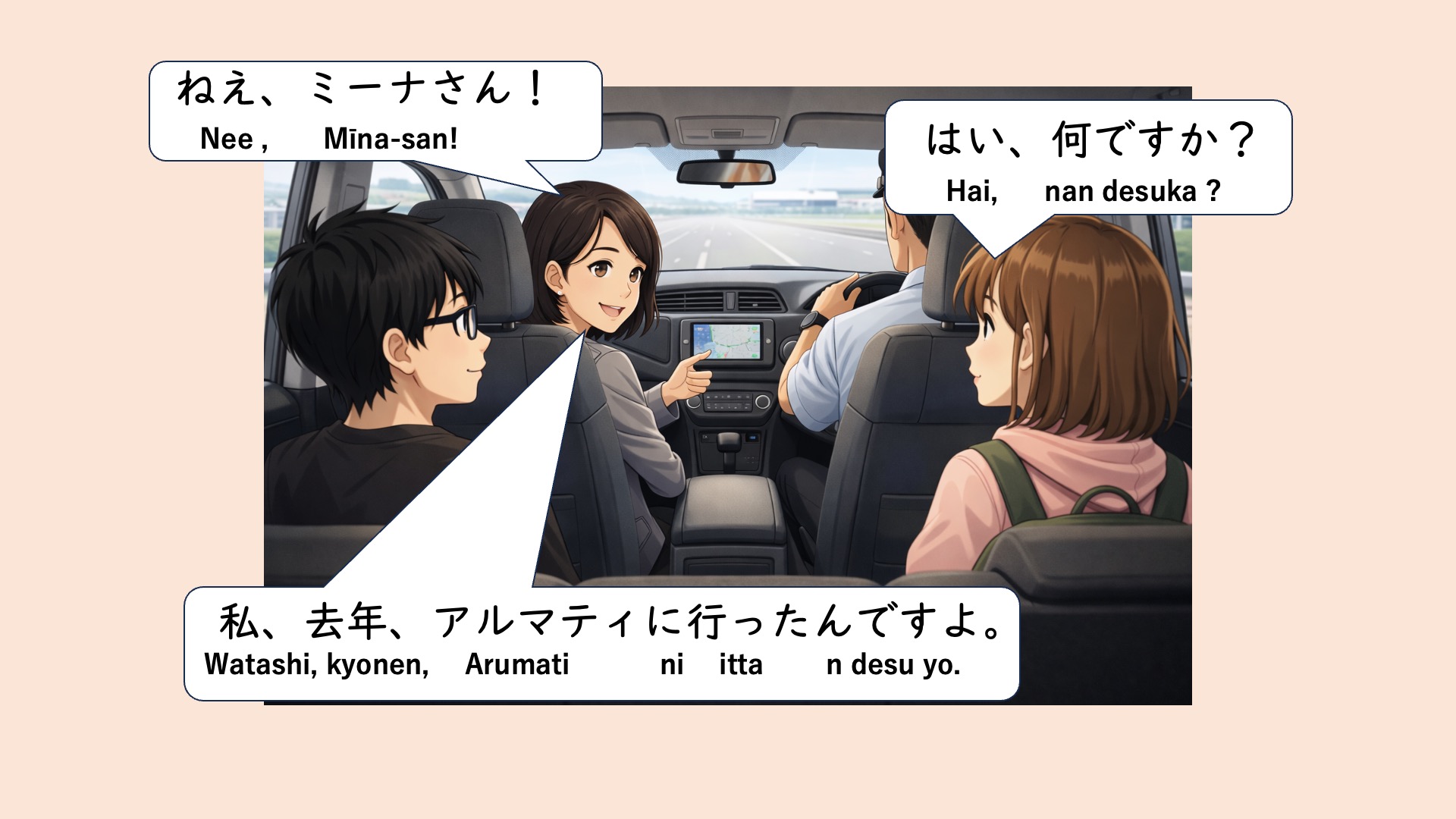
Scene 5 : Mina is talking with Ms. Honda in the car.
第5課 何をしているんですか?
場面 :車の中で本田とミーナが話している
本田 :ねえ、ミーナさん!
ミーナ:はい、何ですか?
本田 :私、去年、アルマティに行ったんですよ。
ミーナ:ええ!本当ですか?
本田 :ええ。アルマティには私の友だちが住んでいるんですよ。
ミーナ:へえ、そうなんですか!
アルマティでは何をしているんですか?
本田 :日本語の先生ですよ。
カザフの大学で日本語を教えているんです。
ミーナ:え?えーっと…四宮…先生?
本田 :そうです、そうです!知っているんですか?
ミーナ:もちろん、知っています。私の先生です。
本田 :ああ、そうだったんですね!
Lesson 5: What do you do?
Scene : Kuruma no naka de Mīna ga Honda sensei to hanasiteiru.
Honda : Nee, Mīna-san!
Mīna : Hai, nan desu ka?
Honda : Watashi, kyonen, Arumati ni itta n desu yo.
Mīna : Ē! Hontō desu ka?
Honda : Ē. Arumati ni wa watashi no tomodachi ga sunde iru n desu yo.
Mīna : Hē, sō nan desu ka!
Arumati de wa nani o shite iru n desu ka?
Honda : Nihongo no sensei desu yo.
Kazafu no daigaku de Nihongo o oshiete iru n desu.
Mīna : E? Ētto… Shinomiya… sensei?
Honda : Sō, sō! Shitte iru n desu ka?
Mīna : Mochiron, shitte imasu. Watashi no sensei desu.
Honda : Ā, sō datta n desu ne!
Lesson 5: What do you do?
Scene : Kuruma no naka de Mīna ga Honda sensei to hanasiteiru.
Honda : Hey, Mina!
Mīna : Yes? What is it?
Honda : I went to Almaty last year.
Mīna : Wow! Really?
Honda : Yes. A friend of mine lives in Almaty.
Mīna : Oh, really?
What does your friend do in Almaty?
Honda : He’s a Japanese teacher.
He teaches Japanese at a university in Kazakhstan.
Mīna : Huh? Um… Professor Shinomiya?
Honda : Yes, that’s right! Do you know him?
Mīna : Of course I do. He’s my teacher.
Honda : Oh, I see!
去年、きょねん、kyonen:Last year. The year before this year.
アルマティ、あるまてぃ、arumati:Almaty. A city in Kazakhstan.
本当、ほんとう、hontō:Really / true. Used to show that something is true or surprising.
友だち、ともだち、tomodachi:Friend. A person you know well and like.
大学、だいがく、daigaku:University / college. A school for higher education.
四宮、しのみや、shinomiya:Shinomiya. A family name.
行った、いった、itta:Went. The past tense of 「行く」.
住んで、すんで、sunde:Living. The te-form of 「住む」.
いる、いる、iru:To be. Used for the existence of people and animals. It is also used after the te-form of a verb, as in 「Vている」
して、して、shite:Doing. The te-form of 「する」.
教えて、おしえて、oshiete:Teaching. The te-form of 「教える」.
知って、しって、shitte:Knowing. The te-form of 「知る」.
( Nothing )
もちろん、もちろん、mochiron:Of course. Used to say yes strongly or naturally.
アルマティには私の友達が住んでいる
「には」 is formed by adding the topic marker 「は」 to the location marker 「に」, which indicates where someone or something exists.
アルマティでは何をしているんですか?
「では」 is formed by adding the topic marker 「は」 to the location marker 「で」, which indicates where an action takes place.
Other words and Expressions
ねえ、nē:Hey. Used to get someone's attention before speaking.
ええ!、ē:Really! Used to express surprise.
ええ。、ē:Yes. A polite affirmative response.
へえ!、hē:Wow! Used to express interest or surprise after hearing new information.
え?、e?:Huh? Used to show surprise or ask someone to repeat what they said.
えーっと、ētto:Uh... / let me see... Used when thinking about what to say.
そう、sō:That's right. Used to confirm that something is correct.
ああ、ā:Oh. Used when you suddenly understand or realize something.
何、なん/なに、nan / nani :what
何ですか
「何」 is read as 「nan」 before 「ですか」 for easier pronunciation.
何をしているんですか
「何」 is read as 「nani」 before the object marker 「を」.