


Lesson 4: Where are you from? - Scene 4 -
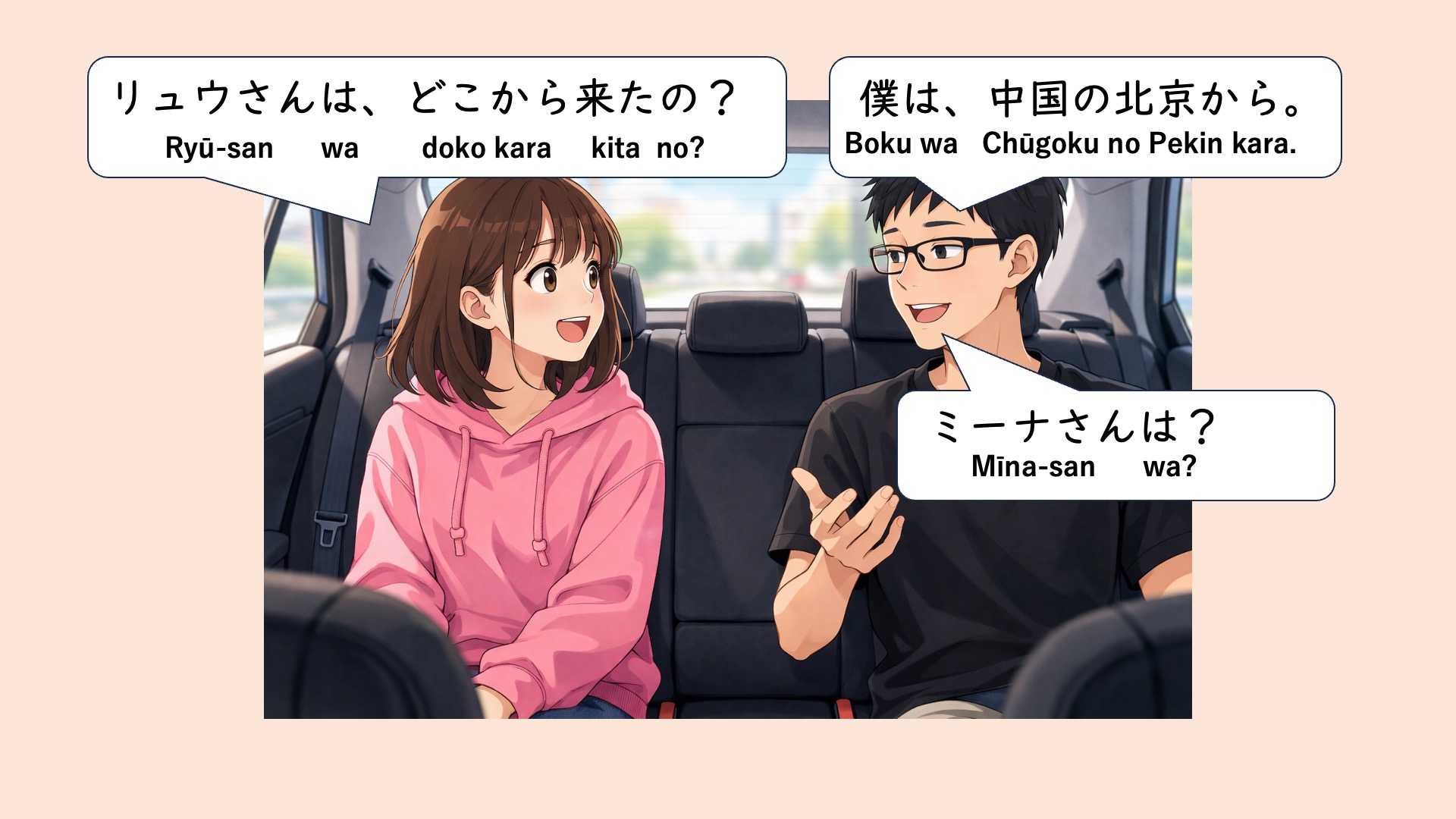
Scene 4 : Mina is talking with Ryu in the car.
第4課 どこから来たの?
場面:車の中でミーナはリュウと話している。
ミーナ:リュウさんはどこから来たの?
リュウ :僕は中国の北京から。ミーナさんは?
ミーナ :私はカザフスタン。
リュウ :え?カザ…ってどこ?ちょっとわからないんだけど…。
ミーナ :カザフスタンよ。あ…ちょっと待ってね。(スマホの地図を出す)
えーっと、これが中国。ここがモンゴル、で、こっちがカザフスタン。
リュウ :へえ、そうなんだ。知らなかった。
ねえ、カザフスタンの首都ってどこ?
ミーナ :え?「首都」って、何?
リュウ :「首都」は、たとえば、日本の首都は東京だよ。
ミーナ :ああ!わかった!カザフの首都は、アスタナよ。
でも、アルマティも大きい街よ。
私の家族はアルマティに住んでいるのよ。
リュウ :ふうん。そうなんだね。
Lesson 4: Where are you from?
Scene : Kuruma no naka de Mīna ga Ryū to hanasiteiru.
Mīna : Ryū-san wa doko kara kita no?
Ryū: Boku wa Chūgoku no Pekin kara. Mīna-san wa?
Mīna : Watashi wa Kazafusutan.
Ryū : E? Kaza… tte doko? Chotto wakaranai n da kedo…
Mīna : Kazafusutan yo. A… chotto matte ne. (Sumaho no chizu o dasu)
Eetto, kore ga Chūgoku. Koko ga Mongoru, de, kocchi ga Kazafusutan.
Ryū: Hee, sō nan da. Shiranakatta.
Nee, Kazafusutan no shuto tte doko?
Mīna : E? “Shuto” tte, nani?
Ryū: “Shuto” wa, tatoeba, Nihon no shuto wa Tōkyō da yo.
Mīna : Aa! Wakatta! Kazafu no shuto wa, Asutana yo.
Demo, Arumati mo ōkii machi yo.
Watashi no kazoku wa Arumati ni sunde iru no yo.
Ryū: Fūn. Sō nan da ne.
Lesson 4 : Where are you from?
Scene : Mina is talking with Ryu in the car.
Mina : Ryu, where did you come from?
Ryu: I’m from Beijing, China. How about you, Mina?
Mina : I’m from Kazakhstan.
Ryu: Huh? Kaza… where’s that? I’m not really sure…
Mina : Kazakhstan. Oh… wait a second. (She opens a map on her phone.)
Um, this is China. Here’s Mongolia, and over here is Kazakhstan.
Ryu: Oh, I see. I didn’t know that.
Hey, what’s the capital of Kazakhstan?
Mina : Huh? What does “capital” mean?
Ryu: “Capital” means—for example, the capital of Japan is Tokyo.
Mina : Ah! I get it! The capital of Kazakhstan is Astana.
But Almaty is a big city, too.
My family lives in Almaty.
Ryu: I see. That’s interesting.
車、くるま、kuruma: Car
中、なか、naka: Inside
中国、ちゅうごく、Chūgoku: China
北京、ぺきん、Pekin: Beijing. The capital city of China.
カザフスタン、かざふすたん、Kazafusutan: Kazakhstan. A country in Central Asia.
モンゴル、もんごる、Mongoru: Mongolia. A country north of China.
首都、しゅと、shuto: Capital
東京、とうきょう、Tōkyō: Tokyo. The capital of Japan.
町、まち、machi: Town / city. A populated area.
アスタナ、あすたな、Asutana: Astana. The capital city of Kazakhstan.
アルマティ、あるまてぃ、Arumati: Almaty. A major city in Kazakhstan.
家族、かぞく、kazoku: Family.
これ、kore: This. Something near the speaker.
ここ、koko: Here. This place.
こっち、kocchi: This way / this side. Direction near the speaker.
知る、しる、shiru: To know. To have information about something.
わかる、わかる、wakaru: To understand. To comprehend something.
待つ、まつ、matsu: To wait. To stay until something happens.
住む、すむ、sumu: To live. To reside in a place.
いる、iru: The verb iru originally means "to exist" or "to be present."
Vている(Vでいる)、teiru (deiru) : When attached to the te-form of a verb, it describes either an ongoing action or the resulting state, depending on the verb.
大きい、おおきい、ōkii: Big. Large in size.
ちょっと、ちょっと、chotto: A little. A small amount.
で、de: And / then. Used to connect ideas.
~から、kara: From. Indicates starting point.
~って、tte: Quoting particle. Marks quoted words or topics.
~よ、yo: Emphasis particle. Adds assertion.
~のよ、no yo: Explanatory emphasis. Soft assertion.
ね、ne: Tag particle. Seeks agreement.
けど、kedo: But. Shows contrast.
V+の?、どうし+の、dōshi + no: (This expression will be explained in this lesson.)
Other words and Expressions
どこ、doko : Where
何、なに、nani : What
ごめん、gomen : Sorry. Casual apology.
えーっと、ē tto : Um. Used when thinking.
へえ、hee : Oh? Expression of surprise or interest.
ねえ、nee : Hey. Used to get attention.
たとえば、tatoeba : For example. Used to give an example.
そうなんだ、sō nan da : I see. Expression of realization.
ふうん、fūn : Hmm. Mild interest or acknowledgment.
NOTE:Vている
When used with ている, some verbs describe a state, while others describe an action in progress.
- 知っている means “to know” or “to be in the state of knowing.”
- 住んでいる means “to live” or “to be living/residing somewhere.”
- 待っている means “to be waiting,” so it describes an action in progress.