



Lesson 4: Where are you from? - Structure 4 -
Structure 4: “~ no da” sentence
1. What is the “~ no da” sentence?
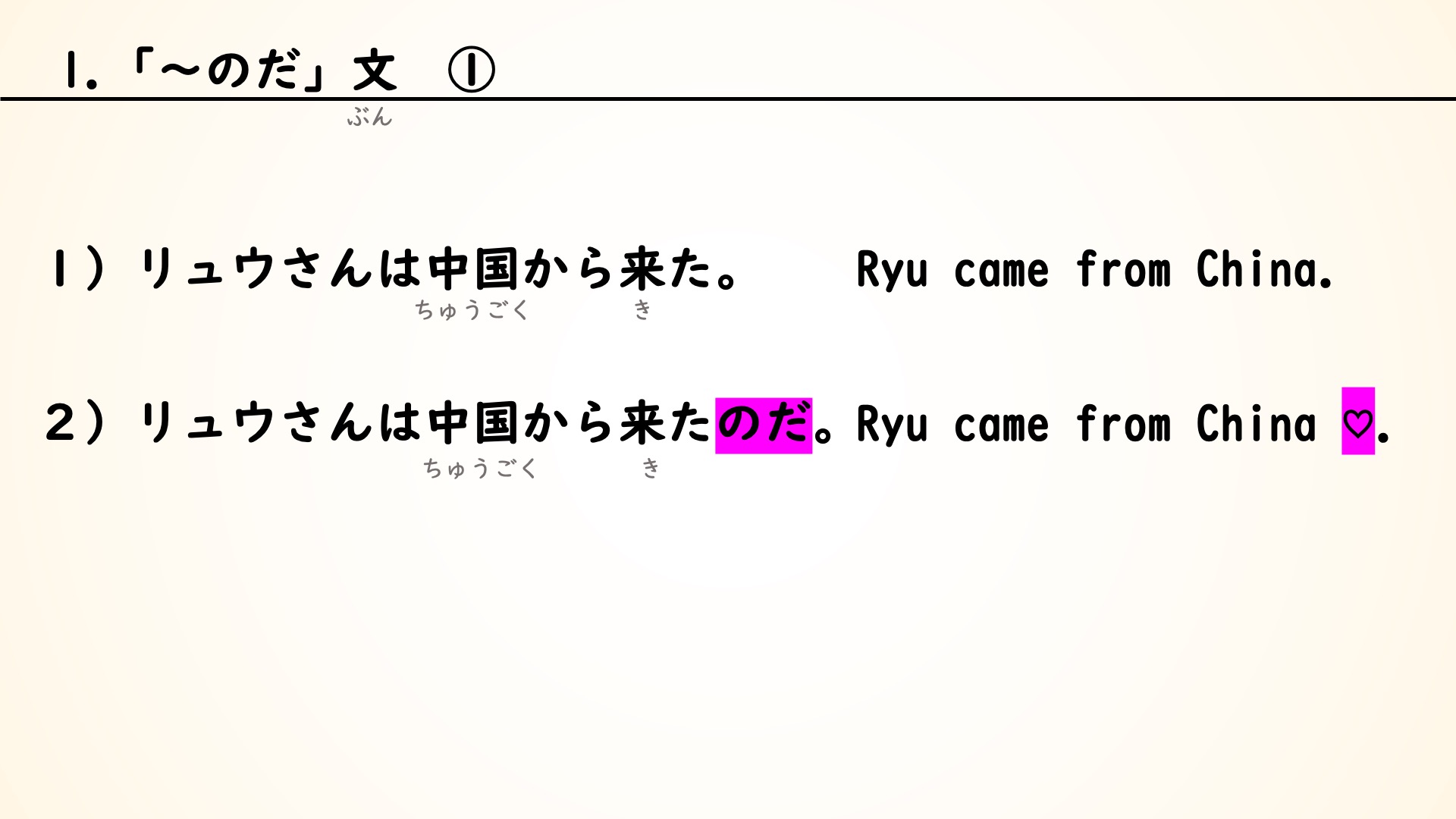
例1)リュウさんは中国から来た。EX.1) Ryu came from China.
Ryu-san wa Chugoku kara kita.
例2)リュウさんは中国から来たのだ。EX.2) Ryu came from China.
Ryu-san wa Chugoku kara kita no da.
In English, both sentences would have the same meaning.
However, in Japanese, they create slightly different impressions.
In Ex.2, the sentence ends with “no da.”
This “no da” adds more than just a simple statement of fact.
In Japanese, it is not only what you say that matters,
but sometimes also how you feel when you say it is reflected in the form of the sentence.
Ex.1 simply states a fact.
Ex.2, however, does more than state the fact that “he came.”
It also carries a nuance like,“I want you to sense my feelings as well.”
Sentences like Ex.2 are called “no da” sentences.
2. Communication Beyond Words in Japanese
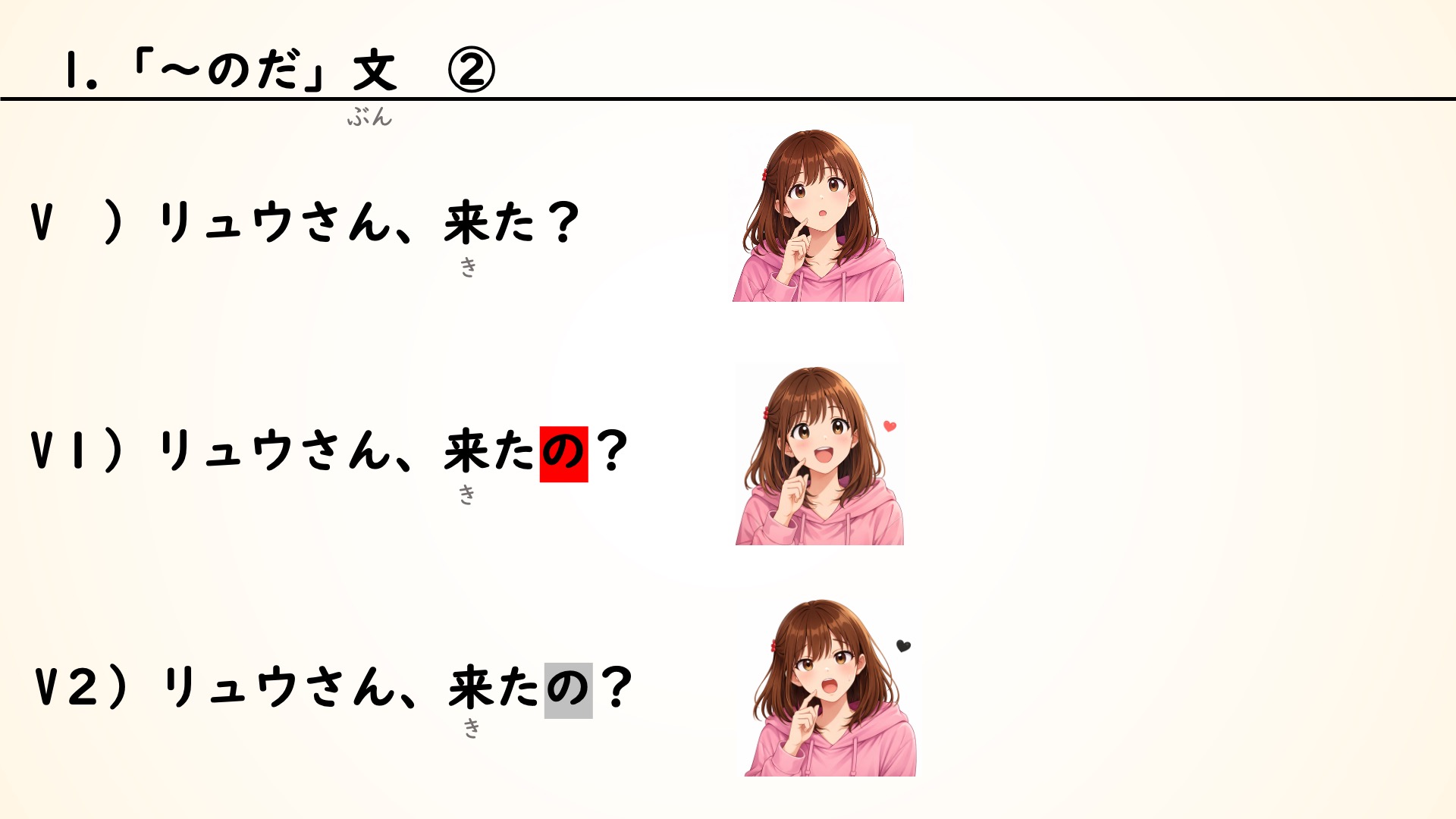
Take a look at the slide above.
V0)リュウさん、来た?
V1)リュウさん、来たの?
V2)リュウさん、来たの?
・・・V0, V1, and V2 are all translated into English as “Ryu, you came.”
First, what about V0? This is a simple question. The speaker is just asking what they are thinking, without adding any particular feeling.
Now, how about V1?When “no?” is added at the end, the sentence carries a sense of feeling.
Looking at the illustration, how does Mina seem to feel? She may look happy.
Then what about V2? It also ends with “no?”, just like V1. However, if you look at the illustration, you will notice something different. This time, Mina seems troubled.
Here is the important point. When a sentence ends with “no,”
it can act as a signal that says, “Please understand how I feel.”
The listener does not rely on words alone. They look at the speaker’s facial expression
and the situation, and try to understand the feeling behind the sentence.
In Japanese, communication often goes beyond the words themselves.
Meaning is shared not only through grammar and vocabulary, but also through tone, sentence endings, facial expressions, and the situation.
This way of sharing meaning is an important part of Japanese as a language.
Just like grammar and vocabulary, it is something you need to know when learning Japanese.
3. Variations of the “~ no da” Sentence
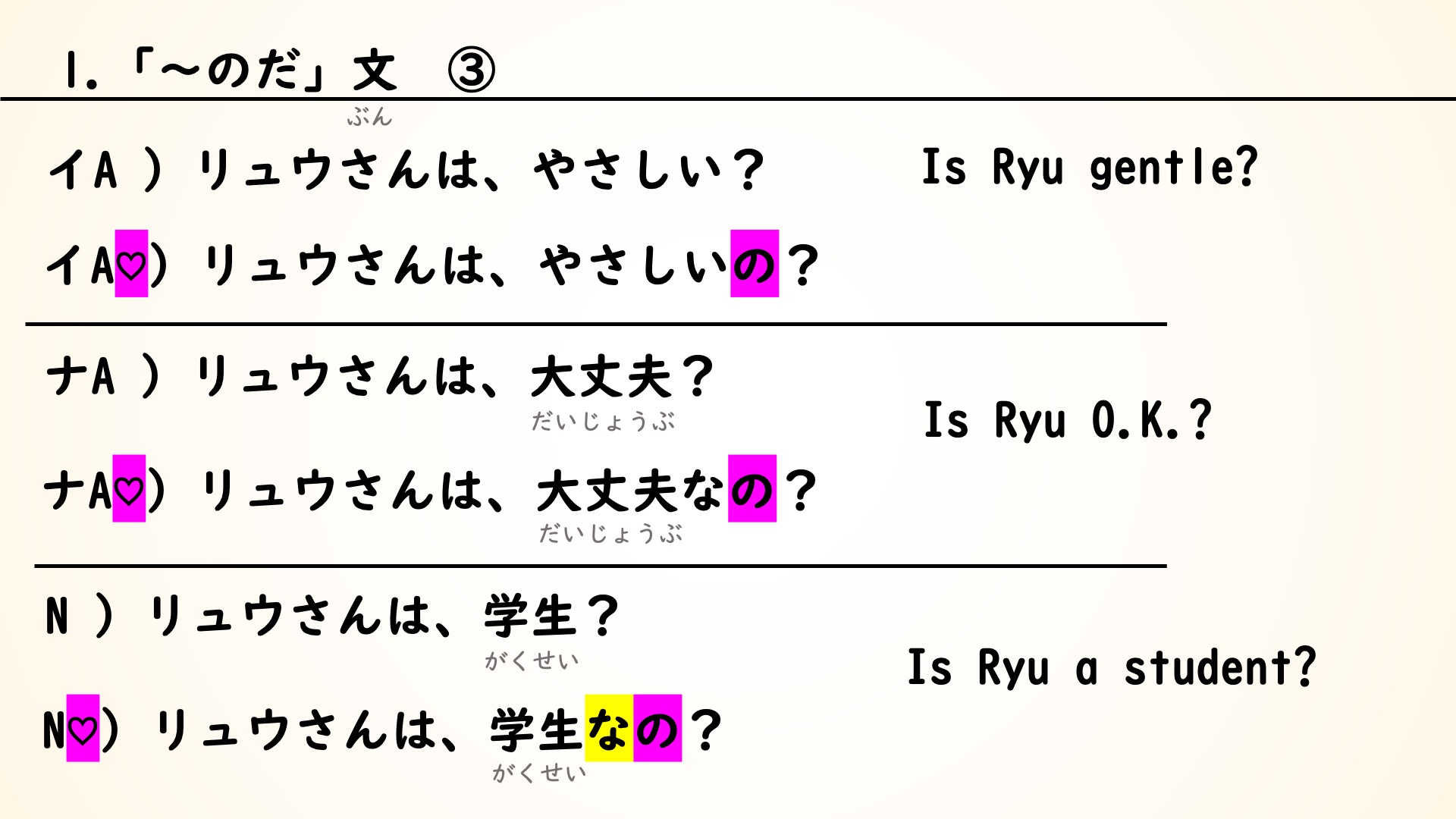
So far, we have looked at “~ no da” sentences with verbs.
However, “~ no da” sentences are not limited to verbs.
You can also use them with I-adj., Na-adj., and nouns.
With both I-adj. and Na-adj.,
you simply add “no?” or “no da” at the end of the sentence.
With nouns, the form changes slightly. You add na before “no?” or “no da,”
as in: N + na + no? or N + na + no da.
4. Men’s and Women’s Speech Styles
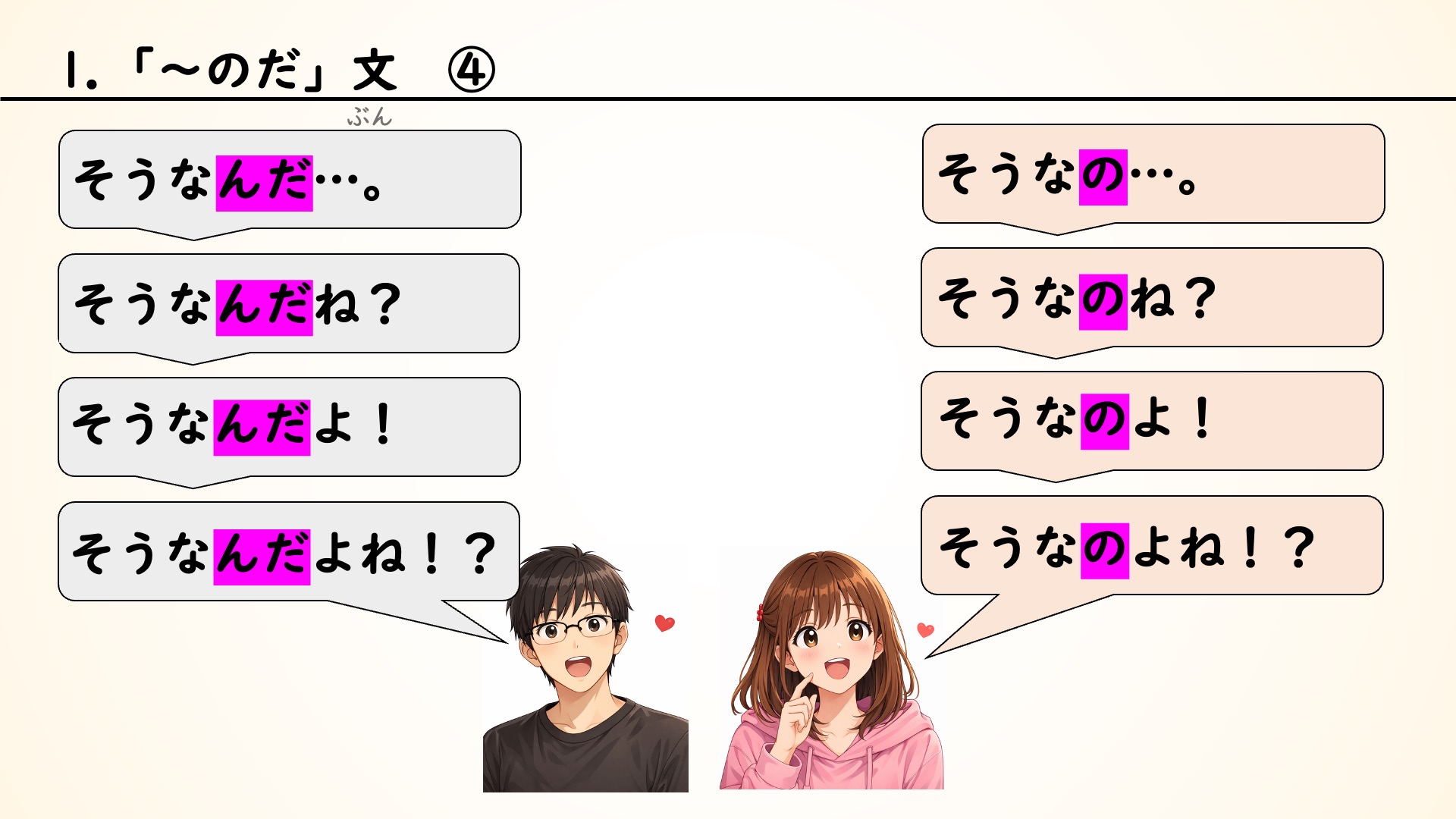
When using “~ no da” sentences,
it’s also helpful to pay attention to differences in speech style.
For example, “Sō nan da…” has a slightly firmer tone and is more commonly used by men.
On the other hand, “Sō na no…” sounds softer and is more commonly used by women.
Of course, neither is wrong.
What matters most is whether it fits your own character
and how people around you actually use these expressions.
Try observing how your Japanese friends speak and choose what feels natural to you.
・そうなんだ… Sō nan da… / そうなの… Sō nano…
English:“Oh, I see…” “I see…”
A simple expression of realization or understanding. It sounds neutral.
・そうなんだね? Sō nan da ne? / そうなのね? Sō nano ne?
English:“Oh, I see, right?” “I see, huh?”
This shows understanding while gently seeking confirmation or shared agreement.
The tone feels softer and more interactive.
・そうなんだよ! Sō nan da yo! / そうなのよ! Sō nano yo!
English:“That’s right!” “Exactly!”
This expresses emphasis or strong agreement. It sounds more energetic and assertive.
・そうなんだよね!? Sō nan da yo ne!? / そうなのよね!? Sō nano ne!?
English:“Exactly, right?!” “See? That’s what I mean!”
This combines strong agreement with a desire for shared understanding.
It feels emotional, enthusiastic, and very interactive.
5. The Polite Form of “~ no da” Sentences
So far, we have looked at “~ no da” sentences in the Normal style.
However, “~ no da” sentences can also be used in the Polite style.
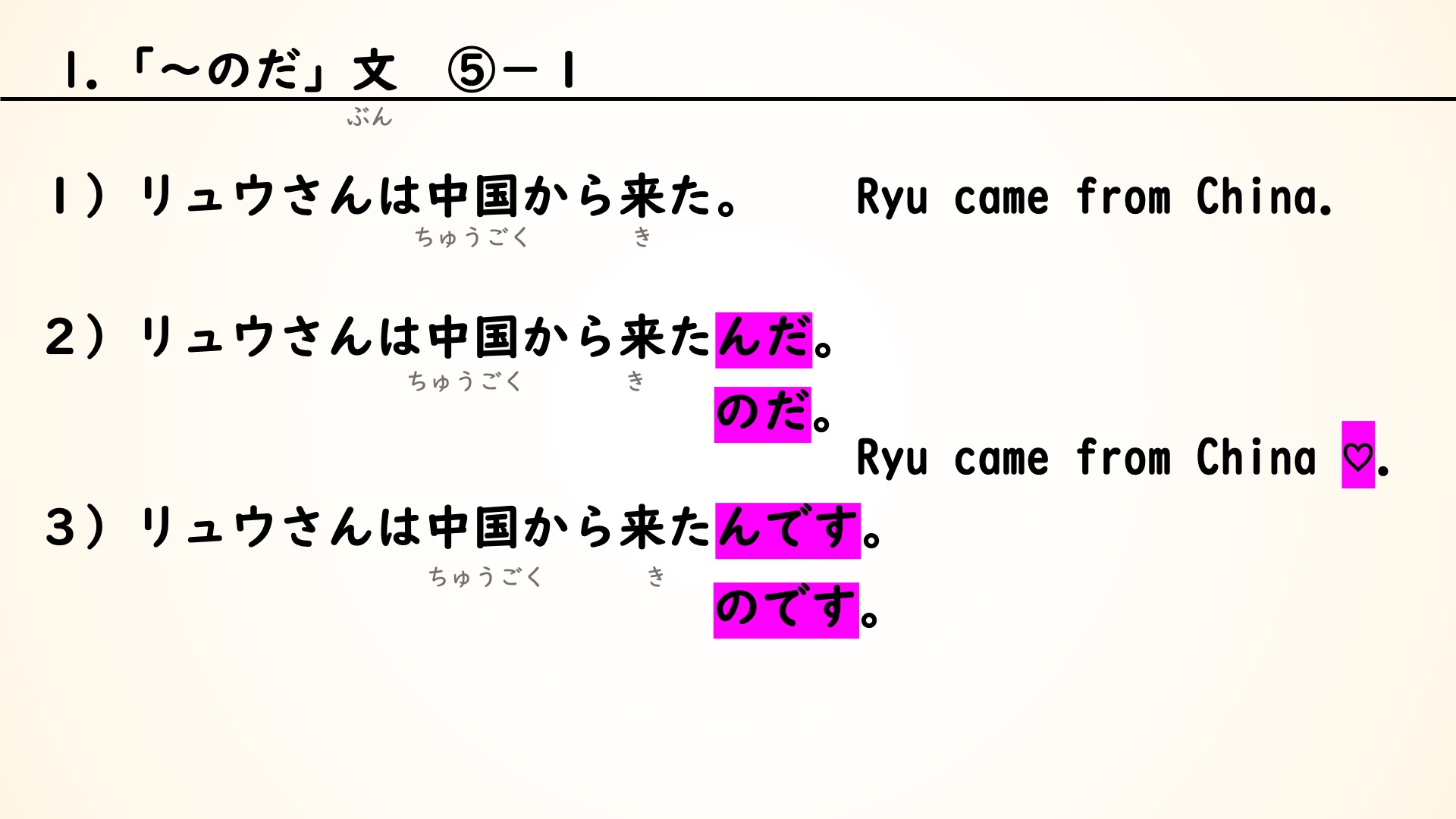
Normal Style : Ryu came from China ♡.
リュウさんは中国から来たんだ(のだ)。
Ryu-san wa Chugoku kara kita nda (no da).
Polite Style : Ryu came from China ♡.
リュウさんは中国から来たんです(のです)。
Ryu-san wa Chugoku kara kita ndesu (no desu).
In the Normal verb sentences, you add “no da” at the end.
In the Polite form, you simply change “da” to “desu”.
Also, “~ no da” sentences sound slightly different in writing and in speech.
In written Japanese, you use “no da” or “no desu”.
In spoken Japanese, however, they are often pronounced as “n da” and “n desu”.
Finally, this pattern is not limited to verbs.
You can also form polite “~ no da” sentences with adjectives and nouns in the same way.
Please check the slides for the specific forms.