







Lesson 1: Welcome to Japan! - Structure 1 -
Structure 1: Grammatical Features
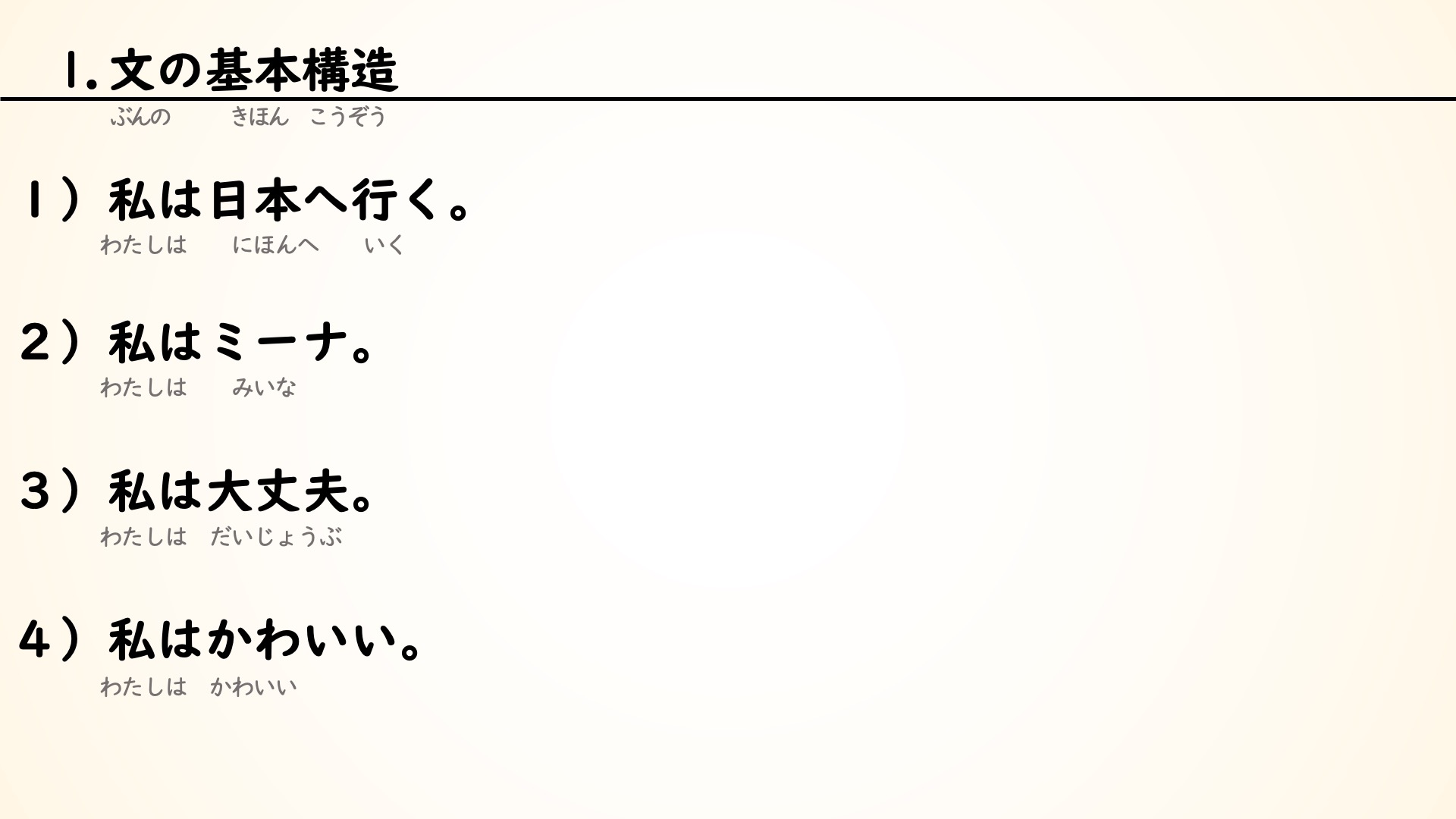
1. Basic Sentence Structure
There are three basic types of sentences in Japanese:
1) verb sentences
2) noun sentences
3) and 4) adjective sentences
Sentence 3) ends with an I-adjective.
Sentence 4) ends with a NA-adjective.
1)動詞文(どうしぶん)
2)名詞文(めいしぶん)
3)と4)形容詞文(けいようしぶん)
Notice !
About NA-adjectives: When do we use "な"?
You use "な" when a NA-adjective comes before a noun.
You do not use "な" when the NA-adjective is at the end of a sentence.
Example:
げんきな せんせい :genkina sensei : an active teacher
せんせいは げんき。:Sensei wa genki. : Teacher is active.
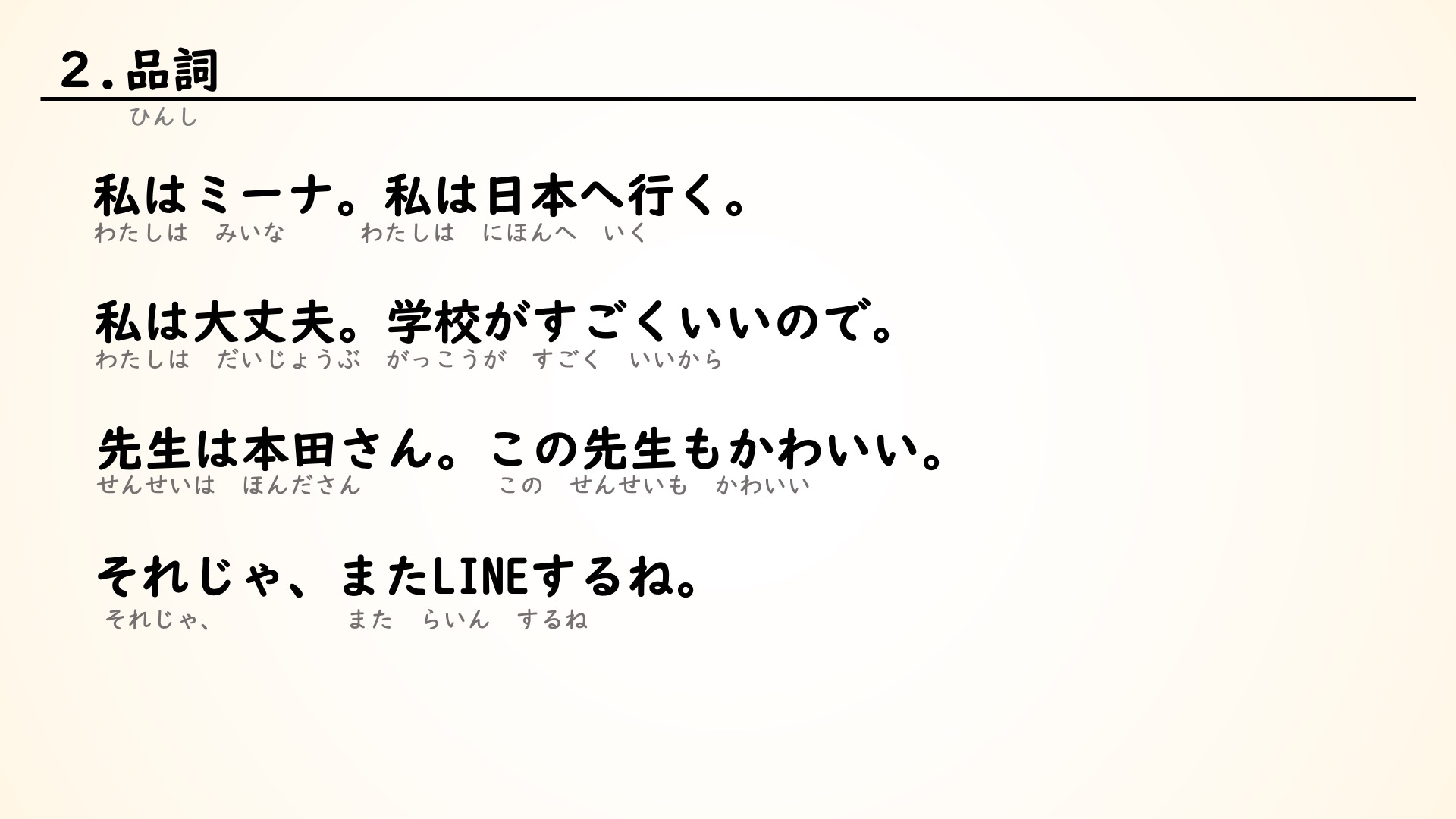
2. Parts of Speech
I am Mina. I am going to Japan.
I’m OK because the school is very good.
The teacher is Mr. Honda. This teacher is also cute.
Well then, I’ll message you on LINE again.
Parts of Speech:
|
動詞 |
名詞 |
い形容詞 |
な形容詞 |
副詞 |
|---|---|---|---|---|
|
Verb |
Noun |
I-Adjective |
NA-Adjective |
Adverb |
|
接続詞 |
その他 |
助詞 |
|---|---|---|
| Conjunction | Others | Particle |
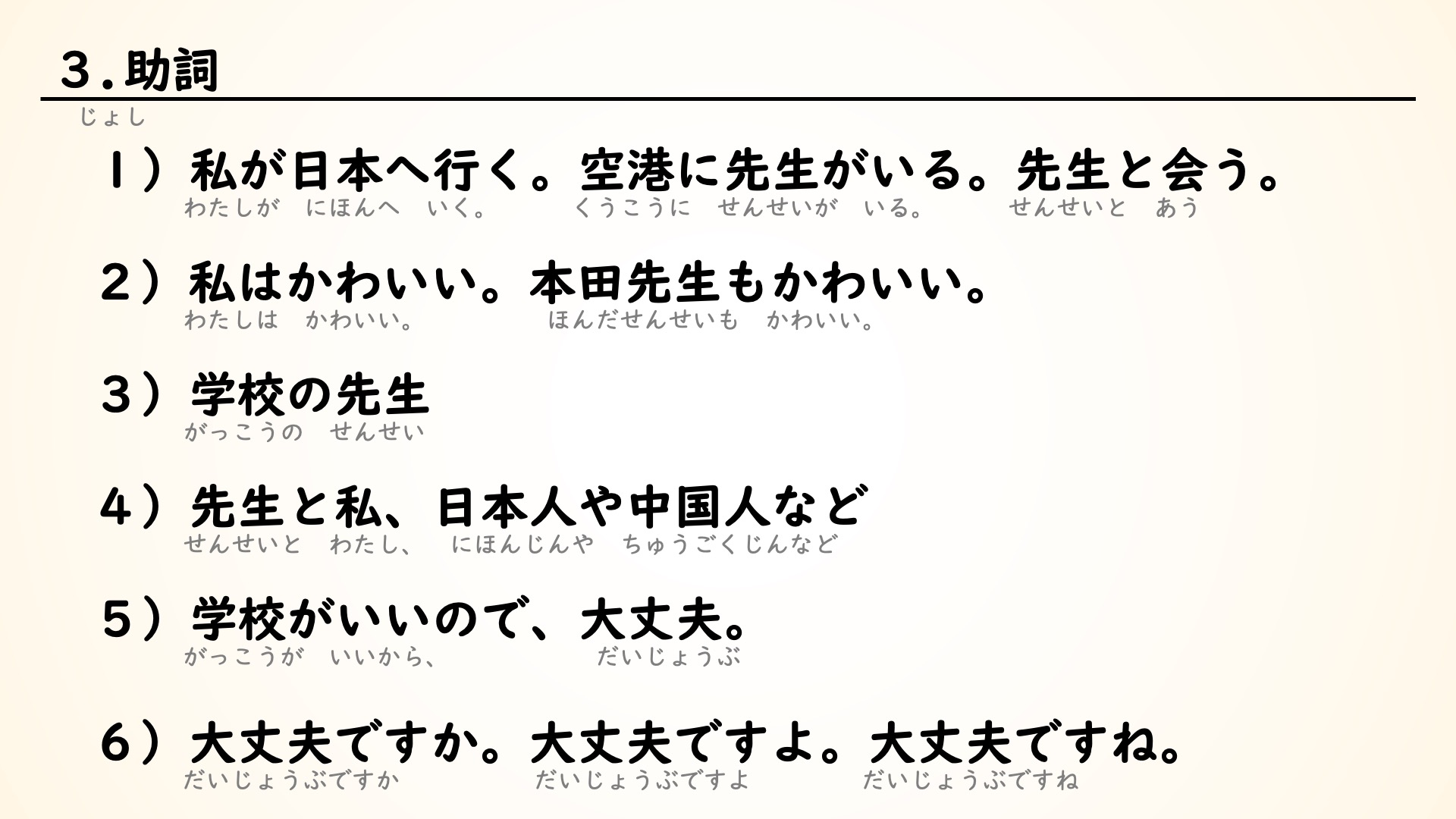
3. Particles
1) I go to Japan. The teacher is at the airport. I meet the teacher.
2) I am cute. Mr. Honda is also cute.
3) a school teacher
4) The teacher and I, Japanese people, Chinese people, etc.
5) The school is good, so it’s OK.
6) Is it OK? It’s OK, you know. It’s OK, right?
Particles can be divided into the following types:
1) Case Particles
格助詞
かくじょし
2) Focus Particles
取立助詞
とりたてじょし
3) Noun-Connecting Particles
連体助詞
れんたいじょし
4) Parallel Particles
並列助詞
へいれつじょし
5) Conjunction Particles
接続助詞
せつぞくじょし
6) Sentence-Ending Particles
が: subject marker
を: object marker
へ: direction marker
※ Pronunciation: [e]
...etc.
は: topic marker; “as for …”
※ Pronunciation: [wa]
も: also, too.
[Noun 1] + の + [Noun 2]
Example: がっこうの せんせい school teacher
Example: A と B、Cなど → A and B, C, …etc.
ので: because, so
[Sentence 1] + ので, [Sentence 2]
Example: 学校がいいので、大丈夫。
→ The school is good, so I’m OK.
けど: but, though
…etc.
Examples: 大丈夫ですか?→ Is it OK?
Examples: 大丈夫ですね?→ It’s OK, right?
Examples: 大丈夫ですよ。→ It’s OK, you know.
…etc.
Notice !
What Is the Topic Marker 「は」?
Japanese is a topic-prominent language, which is different from subject-prominent languages such as English.
In Japanese, part of a sentence is often topicalized and placed at the beginning.
The topicalized element is marked by 「は」, which is written as ha but pronounced wa.
Example:
Ex1)私が日本へ行く。 : Ex1) Nothing is topicalized.
Ex2)私は日本へ行く。 : Ex2)→ “ I” is topicalized.
Ex3)日本へは私が行く。: Ex3)→ “to Japan” is topicalized.
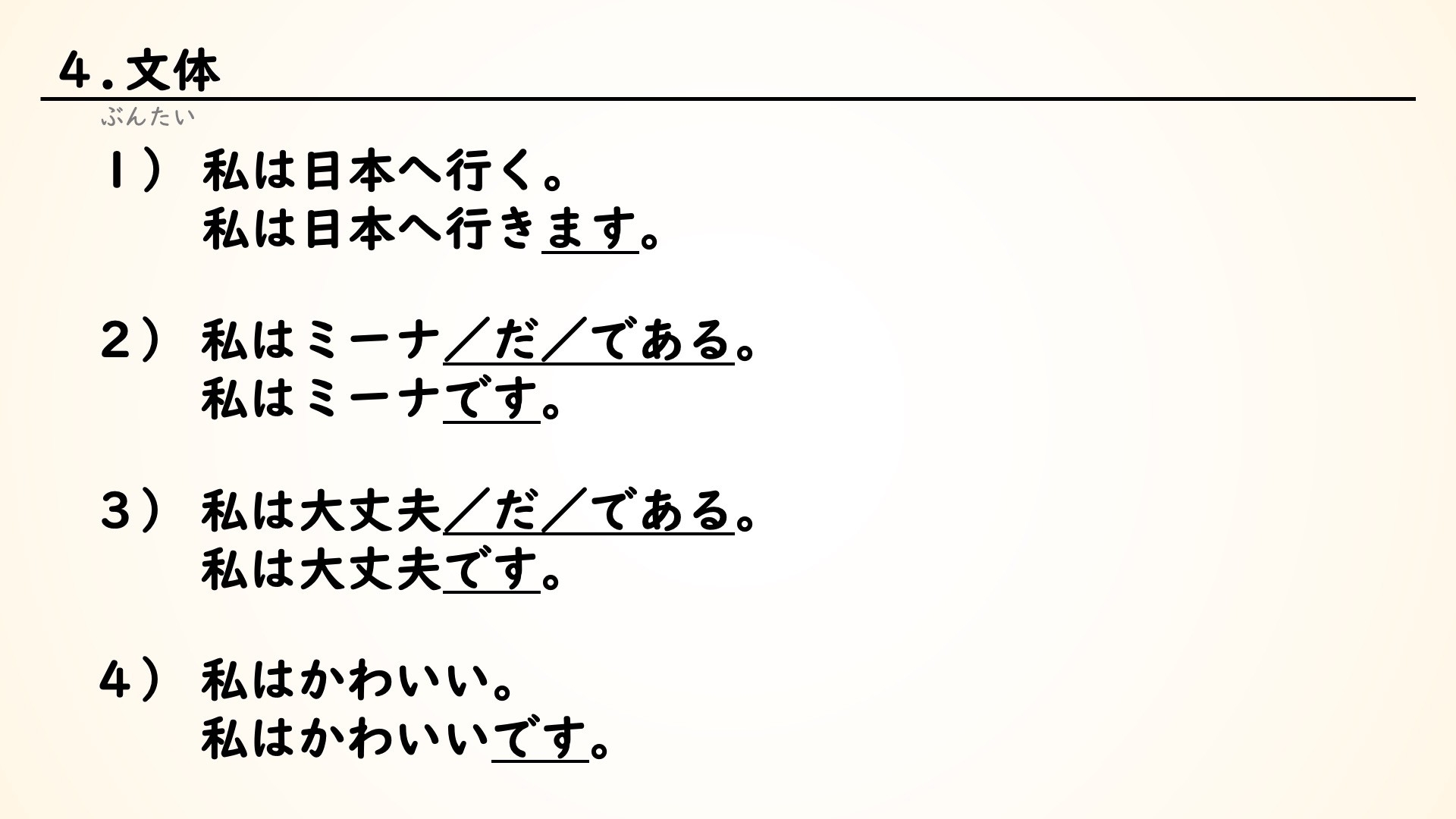
4. Speech Styles
1) I go to Japan.
2) I am Mina.
3) I am OK.
4) I am cute.
Speech styles are chosen according to the person you are talking to and the situation in which you are speaking or writing:
There are two speech styles: the normal style and the polite style:
- The normal style is also called the “da / dearu style.”
- The polite style is also called the “desu / masu style.”
These suffixes are added to verbs, nouns, and adjectives at the end of a sentence.
They are conjugated to express negation, the past tense, and other grammatical meanings.
Ex.) V 動詞(どうし):行く(いく)
|
普通体(ふつうたい) |
丁寧体(ていねいたい) |
|
|---|---|---|
|
非過去(ひかこ) |
いく |
いきます |
|
過去(かこ) |
いった |
いきました |
|
非過去否定(かこ) |
いかない |
いきません |
|
過去否定(かこ ひてい) |
いかなかった |
いきませんでした |
Ex.) N 名詞(めいし):ミーナ
|
普通体(ふつうたい) |
丁寧体(ていねいたい) |
|
|---|---|---|
|
非過去(ひかこ) |
ミーナだ |
ミーナです |
|
過去(かこ) |
ミーナだった |
ミーナでした |
|
非過去否定(かこ) |
ミーナじゃない |
ミーナじゃないです |
|
過去否定(かこ ひてい) |
ミーナじゃなかった |
ミーナじゃなかったです |
Notice !
「じゃない」 is a euphonic form of 「ではない」.
「じゃありません」 sounds more formal than 「じゃないです」.
「じゃありませんでした」 sounds more formal than 「じゃなかったです」.
Ex.) ナA な形容詞(な・けいようし): 大丈夫な(だいじょうぶな)
|
普通体(ふつうたい) |
丁寧体(ていねいたい) |
|
|---|---|---|
|
非過去(ひかこ) |
大丈夫だ |
大丈夫です |
|
過去(かこ) |
大丈夫だった |
大丈夫でした |
|
非過去否定(かこ) |
大丈夫じゃない |
大丈夫じゃないです |
|
過去否定(かこ ひてい) |
大丈夫じゃなかった |
大丈夫じゃなかったです |
Ex.)イA い形容詞(い・けいようし): かわいい
|
普通体(ふつうたい) |
丁寧体(ていねいたい) |
|
|---|---|---|
|
非過去(ひかこ) |
かわいい |
かわいいです |
|
過去(かこ) |
かわいかった |
かわいかったです |
|
非過去否定(かこ) |
かわいくない |
かわいくないです |
|
過去否定(かこ ひてい) |
かわいくなかった |
かわいくなかったです |
Notice !
Male and Female speech style
“Noun + だ” and “Na-adjective + だ” are expressions often associated with male speech.
例1)私は男だ。 ex1) I'm a man.
例2)私は女。 ex2) I'm a woman.
Notice !
Spoken and Written Language
“Noun + dearu” and “Na-adjective + dearu” are generally used in written language.
If you use “dearu” when speaking, you may sound arrogant or overly formal.
Notice !
Polite Speech Style with Honorifics
例1)はじめまして。私はミーナ。
例2)はじめまして。ミーナです。/ミーナと言います(いいます)。
例3)はじめまして。ミーナと申します(もうします)。
Ex1) This is in the normal style and sounds friendly.
Ex2) This is in the polite style.
Ex3) “mōsu” is an honorific verb, and “mōshimasu” is an expression in the polite style with honorific language.